
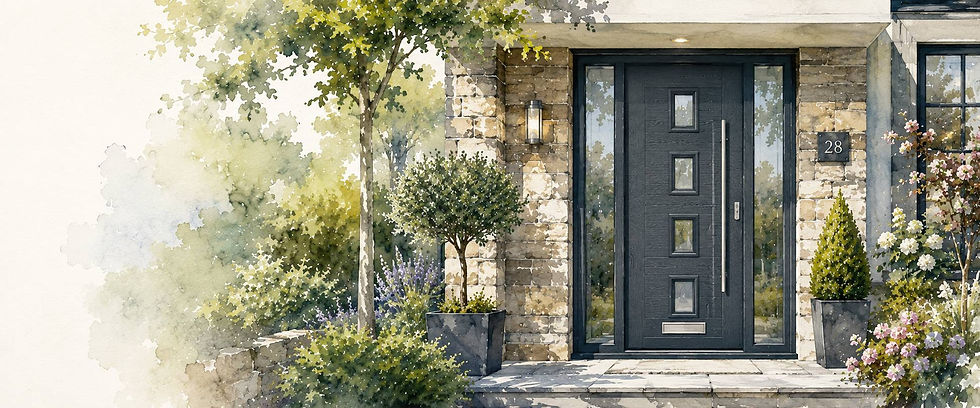
Aluminium Front Doors
Strong, stylish and low-maintenance entrance doors designed for modern homes, extensions and high-quality renovation projects.
Aluminium front doors have become an increasingly popular choice for homeowners looking for a clean architectural appearance, strong security and long-term durability.
With slim profiles, crisp lines and a wide range of powder-coated colours, aluminium external doors work particularly well with contemporary homes, modern extensions and properties fitted with aluminium windows, bifold doors or sliding glazing systems. They can also be used to create a striking contrast on more traditional brick, render or stone elevations.
A well-designed aluminium front door can improve the appearance, warmth and security of the entrance while offering a robust, low-maintenance alternative to timber, UPVC and composite systems.

What Is an Aluminium Front Door?
An aluminium front door is an external entrance door manufactured using aluminium profiles for the door leaf and surrounding frame.
The system may include:
-
Thermally broken aluminium profiles
-
Insulated door panels
-
Reinforced internal sections
-
Double or triple glazing
-
Multi-point locking hardware
-
High-security lock cylinders
-
Weather seals
-
Insulated thresholds
-
Powder-coated finishes
-
Stainless-steel or colour-matched handles
The aluminium provides structural strength and allows the manufacturer to produce relatively slim, precise profiles.
The complete performance of the door depends on much more than the metal itself. The thermal break, panel construction, glazing, seals, frame, threshold and installation all affect security, energy efficiency, weather resistance and comfort.
Why Choose an Aluminium Front Door?
Aluminium entrance doors combine strength, design flexibility and a refined contemporary appearance.
They are particularly suitable where homeowners want:
-
Slim, clean profiles
-
Strong construction
-
Large door sizes
-
Modern colours
-
Low maintenance
-
Long-term durability
-
Large glazed panels
-
A coordinated aluminium glazing scheme
-
Strong security hardware
-
A premium architectural finish
Unlike some traditional door materials, aluminium does not rely on bulky sections to provide strength. This makes it possible to create large, visually simple doors with generous glazing and minimal frame widths.
A Modern Architectural Appearance
One of the main reasons homeowners choose aluminium front doors is their appearance.
Aluminium is naturally suited to clean, modern design. Door faces can be simple and understated or used to create a bold feature at the front of the property.
Popular design features include:
-
Flush or near-flush panels
-
Long vertical glazing
-
Horizontal grooves
-
Oversized pull handles
-
Hidden or minimal hinges
-
Large sidelights
-
Matching fanlights
-
Dark powder-coated finishes
-
Contrasting internal and external colours
-
Integrated house numbers
-
Smart access controls
A modern aluminium front door can work particularly well with white render, natural timber cladding, pale brick, dark roof trims and large areas of contemporary glazing.
It can also provide a strong visual contrast on an older property where the entrance has been deliberately modernised.
Strong and Durable Construction
Aluminium is a strong and stable material.
A properly designed aluminium external door can resist everyday knocks, movement and weather exposure without the same risk of swelling, splitting or warping associated with poorly maintained timber.
Its strength makes it suitable for:
-
Wide entrance doors
-
Tall door openings
-
Large glazed panels
-
Oversized pull handles
-
Matching side panels
-
Contemporary pivot-style designs
-
High-use household entrances
The quality of the profiles and internal construction varies between systems. Homeowners should therefore compare the complete specification rather than assuming that every aluminium door offers the same level of strength or performance.
Improved Home Security
Security is one of the most important considerations when choosing any external door.
Aluminium front doors can be fitted with robust multi-point locking systems and reinforced hardware. Their rigid frames can provide a strong base for locks, hinges and glazing.
Security features may include:
-
Multi-point locking
-
Hook bolts and deadbolts
-
Anti-snap lock cylinders
-
Anti-drill and anti-pick protection
-
Reinforced lock cases
-
Strong hinges
-
Hinge-side security
-
Laminated security glass
-
Secure internal glazing beads
-
Reinforced handles
-
Smart access systems
The performance of the complete door set is more important than any individual component.
A high-security lock will not compensate for poor frame fixing, incorrect alignment or badly installed glazing. Professional installation is essential to ensure that every locking point engages correctly and the outer frame is securely anchored into the building opening.
Thermal Performance and Warmth
Older aluminium doors developed a reputation for feeling cold because early systems often allowed heat to pass through the metal profiles.
Modern aluminium external doors are generally designed with a thermal break. This is an insulating section positioned between the internal and external parts of the frame to reduce heat transfer.
Depending on the product, the door may also include:
-
Insulated cores
-
Multi-chambered thermal breaks
-
Energy-efficient double or triple glazing
-
Low-emissivity glass
-
Warm-edge spacer bars
-
Continuous weather seals
-
Insulated thresholds
-
High-compression closing systems
A properly specified and installed aluminium front door can provide good thermal performance and help reduce draughts around the entrance.
The actual result will depend on the door design, amount of glazing, panel construction and quality of installation.
Reducing Draughts and Heat Loss
An ageing or poorly fitted front door may allow cold air to enter around the frame, threshold or opening sash.
A modern aluminium door can help improve comfort by creating a more accurately fitted and tightly sealed entrance.
The greatest improvement is usually seen where the existing door has:
-
Visible gaps
-
Worn seals
-
A poorly fitting threshold
-
Thin or uninsulated panels
-
Single glazing
-
Distorted frames
-
Difficulty closing or locking
Replacing the door can help remove one weak point in the building envelope, although the overall energy performance of the home will still depend on the windows, walls, roof, floor and heating system.
Noise Reduction
A well-sealed aluminium front door can also help reduce some external noise.
This may be beneficial for properties near:
-
Busy roads
-
Schools
-
Railway lines
-
Airports
-
Town centres
-
Commercial premises
-
Shared entrances
-
High-traffic residential streets
Noise reduction depends on the mass of the door, quality of the seals and specification of any glazing.
Where sound insulation is important, the door may be specified with:
-
Laminated acoustic glass
-
Different glass thicknesses
-
Insulated solid panels
-
Enhanced perimeter seals
-
Carefully designed thresholds
-
Reduced glazed areas
-
High-compression locking systems
Installation quality remains crucial. Even a high-performance door will allow noise to pass through if there are gaps around the frame.
Aluminium Door Colours and Finishes
Aluminium doors are usually powder coated, creating a durable and consistent surface finish.
Popular colours include:
-
Anthracite grey
-
Black
-
Slate grey
-
Light grey
-
White
-
Bronze
-
Champagne
-
Heritage green
-
Navy blue
-
Deep red
-
Metallic finishes
-
Wood-effect finishes
Powder coating allows a wide range of standard and bespoke colours. Some systems can also be specified with different internal and external finishes.
For example, a homeowner may choose an anthracite grey exterior to match aluminium windows while selecting a white or pale internal finish for the hallway.
Dark colours are especially popular, but the final choice should take account of the brickwork, render, roof, paving, window frames and surrounding architectural details.
Black Aluminium Front Doors
Black aluminium front doors can create a strong, confident entrance.
They work well with:
-
White render
-
Red brick
-
Pale stone
-
Timber cladding
-
Modern glazing
-
Black rainwater goods
-
Stainless-steel hardware
-
Monochrome exterior schemes
A simple black door with a long pull handle and narrow vertical glass panel can suit a contemporary home, while a more restrained panel design can work with a renovated period property.
Grey Aluminium Front Doors
Anthracite grey is one of the most popular aluminium door colours in the UK.
It is often chosen to coordinate with:
-
Aluminium bifold doors
-
Sliding doors
-
Modern windows
-
Roof trims
-
Grey fascias and gutters
-
Contemporary extensions
-
Dark garage doors
-
External cladding
Lighter grey shades can create a softer appearance, while deeper tones provide a sharper architectural contrast.
Traditional and Transitional Designs
Although aluminium is commonly associated with modern design, it does not have to look stark or industrial.
Some aluminium front doors are available with:
-
Traditional panel layouts
-
Smaller glazed sections
-
Heritage colours
-
Brass-effect hardware
-
Decorative glazing
-
More conventional handles
-
Side panels and fanlights
-
Subtle wood-effect finishes
These options can help bridge the gap between a traditional property and a modern entrance system.
The proportions and detailing should still respect the character of the building.
Glazing Options
Glazing can make an aluminium entrance feel lighter and bring natural daylight into a dark hallway.
Options may include:
-
Clear glass
-
Frosted glass
-
Textured privacy glass
-
Laminated security glass
-
Toughened safety glass
-
Acoustic glass
-
Solar-control glass
-
Low-emissivity glass
-
Double glazing
-
Triple glazing
-
Decorative glass
-
Integral blinds
Large glazed panels are one of the main design advantages of aluminium, but privacy and security should be considered carefully.
Where the glass is close to the lock or handle, laminated security glass may be appropriate. For exposed entrances, solar-control or acoustic glazing may also be worth considering.
Aluminium Front Doors with Sidelights
Matching side panels can create a wider and more impressive entrance.
They may be glazed, solid or designed to repeat the pattern of the main door.
Sidelights can:
-
Increase natural light
-
Make a narrow hallway feel more open
-
Improve the proportions of a wide entrance
-
Create a more architectural appearance
-
Accommodate an existing oversized opening
However, they will increase the cost and should be specified with appropriate safety, security and privacy glass.
Aluminium External Doors for Rear and Side Entrances
Aluminium is not limited to front doors.
It can also be used for:
-
Back doors
-
Side doors
-
Utility entrances
-
Garden access
-
Home offices
-
Annexes
-
Garage access
-
Contemporary extensions
For a rear extension, an aluminium external door can be coordinated with matching sliding, bifold or fixed glazing systems.
A solid or partially glazed aluminium door may be particularly useful where durability and security are important.
Low Maintenance
Aluminium front doors require relatively little routine maintenance.
They do not normally need regular painting, staining or varnishing. The powder-coated finish is designed to withstand normal weather exposure and retain its appearance over time.
Routine maintenance may include:
-
Cleaning with warm soapy water
-
Wiping down the frame and panel
-
Cleaning glass
-
Keeping drainage channels clear
-
Lubricating locks and hinges as recommended
-
Checking seals
-
Tightening loose hardware
-
Removing debris from the threshold
Abrasive products, strong solvents and unsuitable chemicals should be avoided because they may damage the powder-coated finish, seals or hardware.
Aluminium Doors Versus Composite Doors
Aluminium and composite doors both offer strong security and a premium appearance, but they have different characteristics.
Aluminium doors are often:
-
Slimmer in appearance
-
More architectural
-
Suitable for larger sizes
-
Better suited to extensive glazing
-
Easier to coordinate with aluminium windows
-
Available in a wide range of powder-coated colours
Composite doors are often:
-
Heavier in feel
-
More traditional in appearance
-
Available in a wider range of moulded panel styles
-
More likely to feature realistic timber grain
-
More familiar for standard front-door openings
The best choice depends on the style of the property, required size, budget and desired appearance.
Aluminium Doors Versus UPVC Doors
UPVC doors are generally more economical and work well for many standard residential entrances.
Aluminium doors are usually chosen where the priorities include:
-
Slim profiles
-
Stronger architectural styling
-
Larger openings
-
Premium finishes
-
Coordinated aluminium glazing
-
Long-term rigidity
UPVC may offer better value for a straightforward back or side door, while aluminium may be more appropriate for a feature entrance or contemporary renovation.
Aluminium Doors Versus Timber Doors
Timber offers natural warmth and traditional character, making it suitable for period, listed and conservation properties.
Aluminium offers:
-
Lower routine maintenance
-
Greater dimensional stability
-
Slimmer profiles
-
Consistent factory finishes
-
Strong weather resistance
-
Larger design possibilities
Timber may remain preferable where authentic joinery and traditional detailing are essential. Aluminium is often better suited to modern architecture and households seeking minimal maintenance.
Aluminium Front Door Prices
Aluminium front door prices vary significantly depending on the system and level of customisation.
The final cost may be affected by:
-
Door size
-
Panel design
-
Frame specification
-
Thermal performance
-
Amount of glazing
-
Glass type
-
Colour
-
Bespoke powder coating
-
Handles and hardware
-
Locking system
-
Smart access controls
-
Sidelights
-
Fanlights
-
Threshold type
-
Removal of the old door
-
Installation complexity
-
Making good around the opening
A standard single aluminium door will usually cost less than an oversized entrance with full-height sidelights, premium hardware and specialist glazing.
Homeowners should compare written quotations carefully and confirm whether the price includes:
-
Survey and measurement
-
Door and frame
-
Glazing
-
Handles and locks
-
Threshold
-
Removal of the old door
-
Installation
-
Sealing
-
Internal and external making good
-
Disposal
-
Product guarantees
-
Workmanship guarantees
Cost Versus Long-Term Value
Aluminium front doors tend to cost more than basic UPVC doors.
However, the higher initial cost may be justified where the homeowner values:
-
Strong construction
-
Slim design
-
Large door sizes
-
Low maintenance
-
Durable finishes
-
Modern styling
-
Coordinated aluminium windows and doors
-
Long-term stability
The cheapest product is not always the best value.
A detailed specification should be compared alongside the price, including security, thermal performance, glass type, hardware, frame construction and installation.
How Long Do Aluminium Front Doors Last?
A good-quality aluminium door can provide a long service life when correctly installed and maintained.
The aluminium frame and powder-coated finish are generally durable, although hardware components such as locks, hinges, handles, cylinders and seals may require adjustment or replacement over time.
Longevity will depend on:
-
Product quality
-
Exposure
-
Coastal conditions
-
Frequency of use
-
Installation quality
-
Door alignment
-
Hardware maintenance
-
Cleaning
-
Drainage
-
Finish specification
A door that becomes difficult to close or lock should be adjusted promptly to avoid unnecessary strain on the locking system and hinges.
Common Aluminium Door Problems
Possible issues may include:
-
Misalignment
-
Difficulty locking
-
Stiff handles
-
Worn hinges
-
Failed seals
-
Draughts
-
Water penetration
-
Scratched finishes
-
Condensation within glazed units
-
Threshold movement
-
Damaged lock cylinders
Many of these problems can be repaired without replacing the entire door.
Locks, cylinders, hinges, seals, handles and glazing can often be serviced or replaced separately.
Professional Aluminium Door Installation
The quality of the installation has a major effect on the performance of the door.
A professional installation should include:
-
Accurate measurement
-
Careful removal of the existing door
-
Correct frame positioning
-
Secure mechanical fixing
-
Appropriate packers and supports
-
Accurate levelling and alignment
-
Proper perimeter sealing
-
Correct threshold installation
-
Adjustment of locks and hinges
-
Testing of every locking point
-
Internal and external making good
-
Explanation of operation and maintenance
The door should open, close and lock smoothly without excessive force.
The installer should also provide details of the door specification, glazing, security features, finishes and guarantees.
Choosing the Right Aluminium Front Door
Before ordering, homeowners should consider:
-
Door size
-
Style of the property
-
Preferred colour
-
Internal and external finish
-
Amount of glazing
-
Privacy requirements
-
Security specification
-
Thermal performance
-
Noise exposure
-
Handle type
-
Threshold height
-
Accessibility
-
Opening direction
-
Sidelights
-
Fanlights
-
Smart lock requirements
The door should be designed as part of the whole elevation rather than chosen in isolation.
The colour and proportions should work with the windows, roof, brickwork, render, paving, lighting and surrounding entrance details.
Are Aluminium Front Doors Worth It?
For homeowners looking for a strong, modern and low-maintenance entrance, aluminium front doors can offer excellent long-term value.
They are particularly suitable where the priorities include:
-
Contemporary design
-
Strong security
-
Slim profiles
-
Large door sizes
-
Durable powder-coated finishes
-
Low maintenance
-
Generous glazing
-
Coordinated aluminium windows and doors
-
Improved kerb appeal
The best results come from choosing a suitable design, checking the full technical specification and using an experienced installer who will measure, fit and adjust the door correctly.
Find Trusted Aluminium Door Installers
The quality of the installation is just as important as the aluminium front door you choose. APN Double Glazing can help connect you with experienced local installers who can assess your property, explain the available styles, colours, security features and glazing options, and provide a clear quotation based on your requirements.
Get in touch for expert advice and a free, no-obligation quote today.